Principal investigator
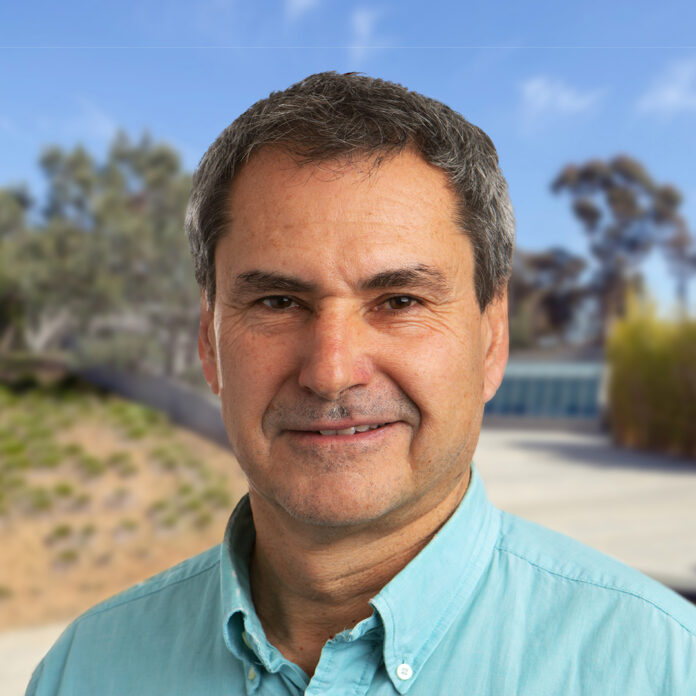
Michel Sanner
Professor of Molecular Biology, Department of Integrative Structural and Computational Biology, Scripps Research. Faculty page · Google Scholar · sanner@scripps.edu
Michel Sanner received his Ph.D. in Computer Science from the University of Haute Alsace, France, in 1992. His laboratory develops computational methods for predicting molecular interactions, including the widely used AutoDock4 and tools for docking small molecules, proteins and peptides. He also has a long-standing interest in software engineering: the lab builds reusable software components that can be assembled quickly into custom applications, such as PMV, AutoDockTools and the visual programming environment Vision.
Postdoctoral fellows
Research
The lab develops computational methods for predicting how biological molecules recognize and bind each other, and turns them into software that other researchers can use. Our work spans molecular surfaces, docking of small molecules and peptides, and the software engineering that lets these methods be combined into new applications. Papers are listed on the Publications page.
Peptide docking
Peptides are flexible, so predicting how one binds a protein means folding it and docking it at the same time. AutoDock CrankPep (ADCP) does both, combining physics-based folding with focused docking into a known binding region, and it handles linear and cyclic peptides. ADCP is regarded as a state-of-the-art physics-based peptide docking method. We have also shown that it complements deep-learning structure predictors: independent physics-based sampling and scoring can refine and re-rank AI-generated models of protein–peptide complexes.
Protein–ligand docking and binding sites
We contributed flexible receptor side chains to AutoDock4, one of the most widely used docking programs. AutoDockFR (ADFR) extends this with explicitly specified binding-site flexibility, AGFR prepares receptors and docking maps, and AutoSite finds ligand-binding sites and predicts where key ligand atoms are likely to sit.
Molecular surfaces
MSMS computes solvent-excluded molecular surfaces quickly and reliably. It is built into Chimera, VMD, MGLTools and many other programs and pipelines.
Scientific software engineering
Early computational biology programs were hard to reuse and maintain. We pioneered a component-based architecture built around Python, in which reusable modules for computation and visualization can be assembled quickly into new applications; the 1999 paper describing it has been cited more than 4,600 times. This approach produced the Python Molecular Viewer (PMV), AutoDockTools and the visual programming environment Vision, distributed together as MGLTools to more than 20,000 registered users, and it has been reused in augmented reality, animation and cellular modeling, including CellPACK. Michel Sanner was also a founding member of the SciPy conference.
Funding
The lab’s work, including the software on this site, is supported by the National Institutes of Health (NIH):
| Award | NIH institute | Years | Project |
|---|---|---|---|
| R35 GM152084 | NIGMS | 2024–2029 | Structure-based in-silico prediction of peptide interactions |
| R01 GM096888 | NIGMS | 2011–2025 | AutoDockFR and flexible receptor docking, then in-silico prediction of protein–peptide interactions |
| P41 RR008605 (subproject) | NCRR | 2004–2012 | Visualization environments for multi-scale biomedical modeling |
| R21/R33 GM065609 | NIGMS | 2003–2010 | Representation of flexible biomolecular shapes |
NIGMS: National Institute of General Medical Sciences. NCRR: National Center for Research Resources. The content of this website is solely the responsibility of the authors and does not necessarily represent the official views of the National Institutes of Health.
Alumni
Postdoctoral fellows
- Yong Zhao, until 2008, then CambridgeSoft
- Donald Keidel, 2008–2011, then eMolecules
- Matthew Danielson, 2011–2013, then Eli Lilly
- Pradeep Ravindranath, 2013–2016. Founder and CEO, DynamWorks · LinkedIn · Google Scholar
- Yuqi (Gary) Zhang, from 2017. Schrödinger, San Diego · ORCID
- Vera Prytkova
- Sudhanshu Shanker, 2022–2023. Assistant Professor, Mahindra University · Faculty page
Programmers
- Ruth Huey, 1999–2016 (in memoriam)
- Sophie Coon, 2000–2004. Neurocrine Biosciences · LinkedIn
- Frédéric Giacometti, 2001–2003
- Guillaume Vareille, 2006–2009
- Sargis Dallakyan, 2006–2014. Senior Software Engineer, Rady Children’s Hospital–San Diego · LinkedIn
- Alexandre Gillet. Principal Software Engineer, PacBio · LinkedIn
- Anna Omelchenko, until 2021
Students and interns
- Chris Carrillo, La Jolla High School
- Dagny Whall, 2021, La Jolla High School
- Harpreet Singh Saluja, 2022, UC San Diego
- Dayna Olson, 2022, Michigan State University
- Katherine Ge, 2022, Stanford University