AutoSite identifies and characterizes binding sites in macromolecules of known three-dimensional structure (the receptor). It finds binding sites by clustering high-affinity points; each cluster corresponds to a potential binding pocket.
Points within a cluster are labeled by their preference for hydrophobic ligand atoms or for hydrogen-bond donor or acceptor ligand atoms, which gives a “colored” description of the pocket. From these colored points AutoSite derives a set of putative positions for hydrophobic and hydrogen-bonding ligand atoms, called feature points.
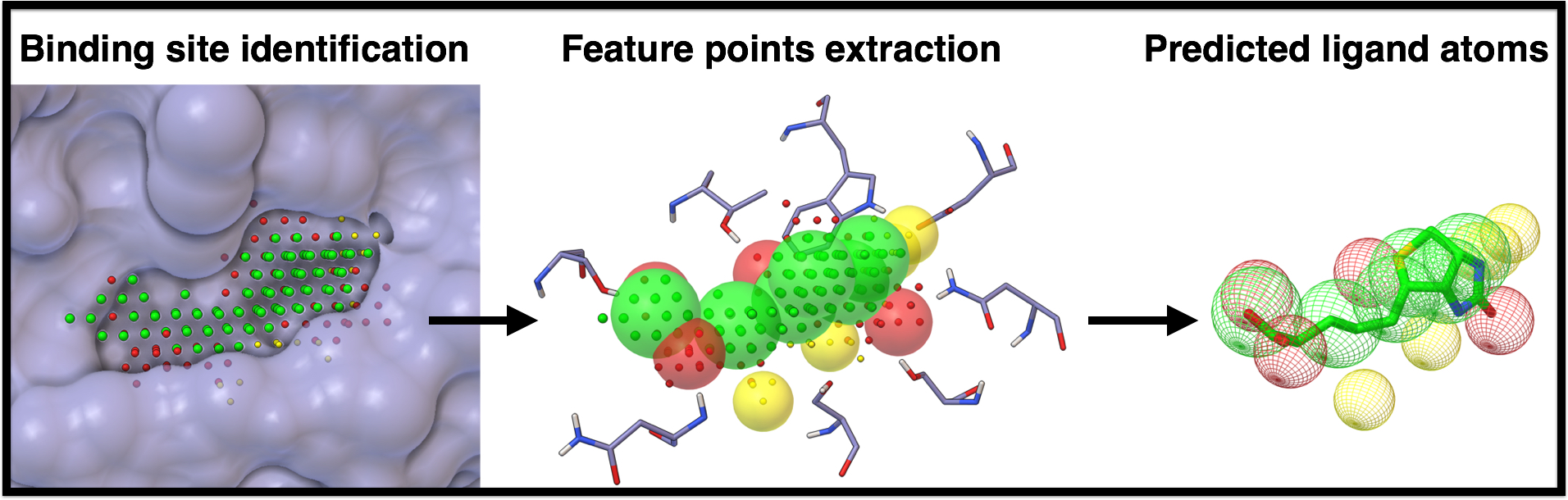
In the published benchmark, AutoSite outperformed state-of-the-art energy- and geometry-based methods at identifying the binding sites of known ligands. For the 85 ligands of the Astex Diverse Set, it placed feature points of the right type within 2.0 Å of 79% of hydrophobic ligand atoms, of 81% of hydrogen-bond acceptor ligand atoms bonded to the receptor, and of 63% of hydrogen atoms forming hydrogen bonds with the receptor.
AutoSite is used by AutoGridFR (AGFR) to identify binding pockets. The AGFRgui graphical interface runs AutoSite calculations and lets you inspect the clusters of points that fill the pockets.
Versions
AutoSite is distributed with ADFRsuite 1.0, which contains AutoSite 1.0 and 1.1. In AGFR the version is chosen with -asv 1.0 or -asv 1.1. The AGFR documentation describes version 1.0 as meant for small molecules, and version 1.1 as somewhat slower but giving better pocket descriptions for larger ligands such as peptides.
License
AutoSite is distributed under the Sannerlab MIT-like Source-Available License.
How to cite
If you use AutoSite in your work, please cite:
- Ravindranath, P. A.; Sanner, M. F. AutoSite: an automated approach for pseudo-ligands prediction, from ligand-binding sites identification to predicting key ligand atoms. Bioinformatics 2016, 32 (20), 3142–3149. doi:10.1093/bioinformatics/btw367