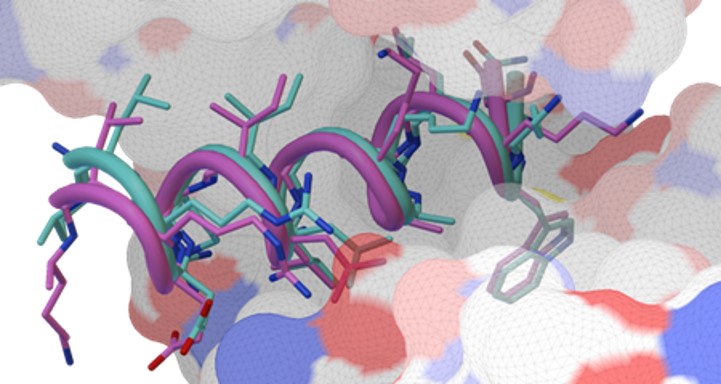
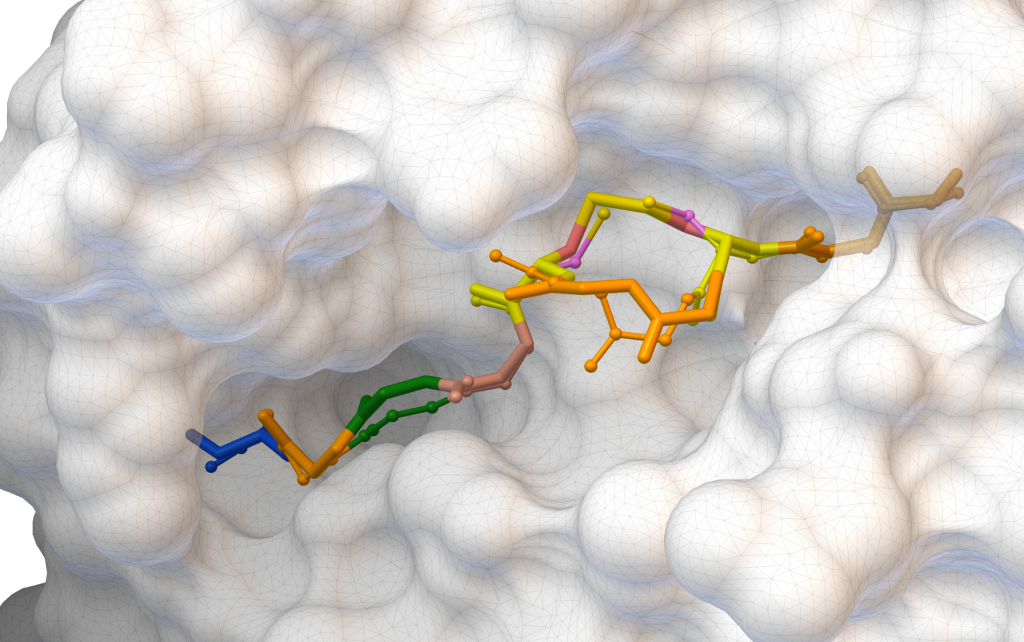
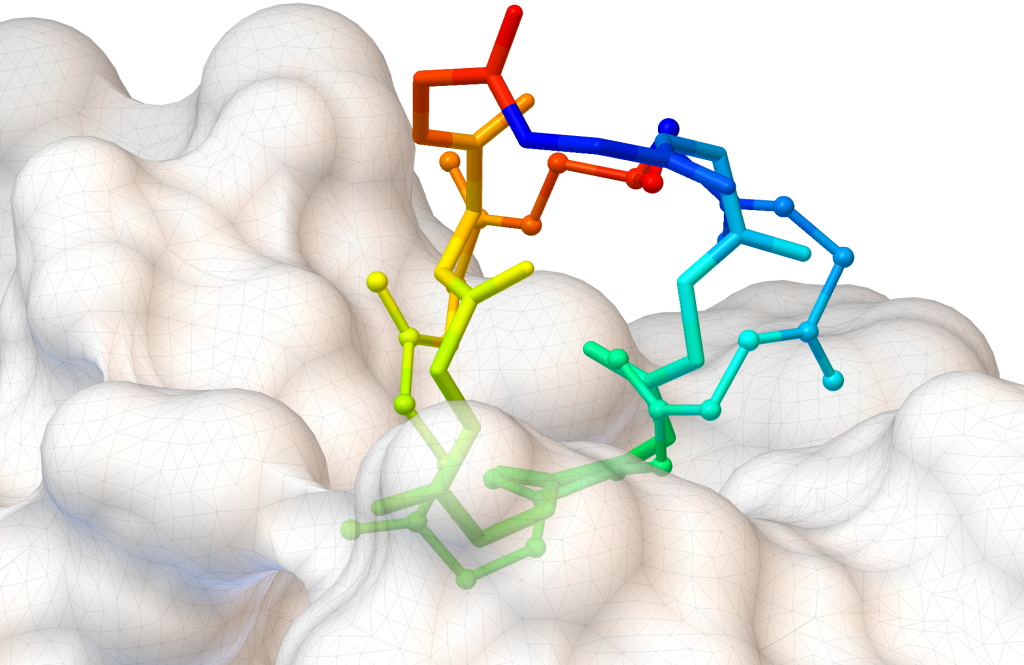
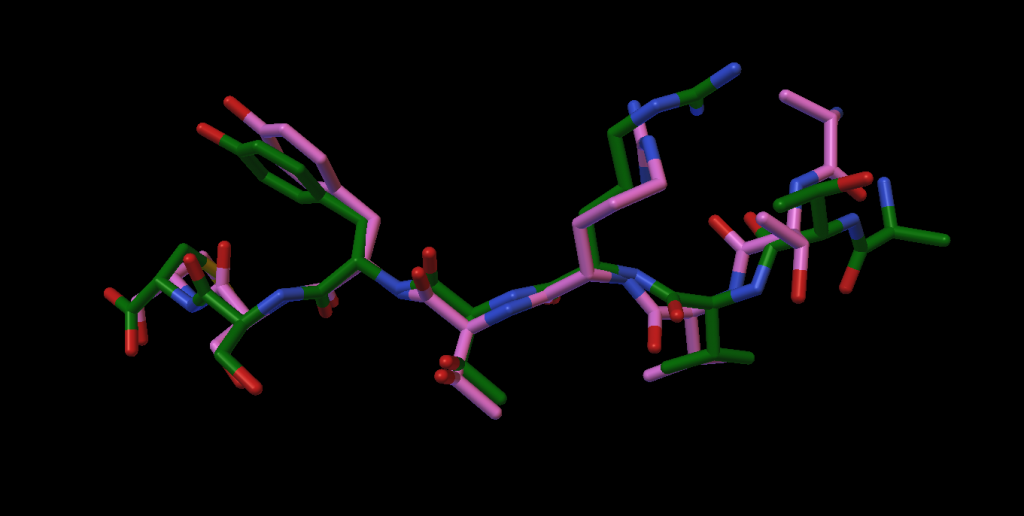
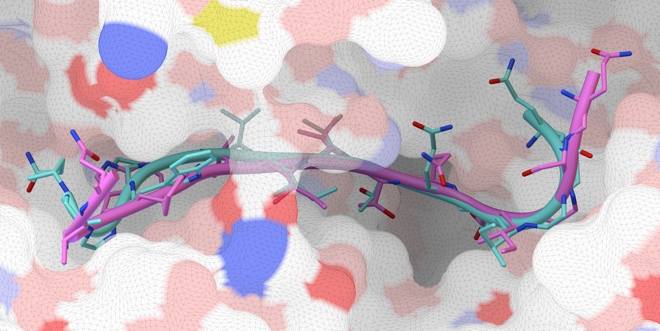
AutoDock CrankPep (ADCP) is a docking engine specialized for peptides. It combines a protein folding technique with AutoDock’s efficient representation of a rigid receptor as affinity grids. A Monte Carlo search folds the peptide while it optimizes the peptide’s interaction with the receptor, which yields docked peptides. ADCP takes a peptide as a sequence string, or as a 3D structure in a PDB file (-i), and has docked peptides of up to 20 amino acids successfully.
Versions
| Version | Status | Platforms | Install |
|---|---|---|---|
| 1.1 | current | Linux (macOS through an Ubuntu virtual machine) | micromamba or conda, Download |
| 1.0 | deprecated | Linux, macOS (Windows through WSL) | ADFRsuite 1.0 installer, Download |
What changed in version 1.1
Version 1.1 adds support for non-standard amino acids and lets you minimize docked poses with OpenMM. In detail:
- Streamlined output. Docked poses are saved in a single multi-model PDB file,
xxx_out.pdb, wherexxxis the job name (or a default name), and a summary filexxx_summary.dlgis written. - Full side chains. Docked poses contain all-atom side chains instead of a rotamer index.
- Number of poses. Set how many docked poses to write with
-m/--nmodes. - Command line changes. The target file is given with
-Tand can be a.trgfile or a folder containing one. The new option-kkeeps calculation details. - Rotamer libraries. Side-chain rotamers are loaded from
.libtext files; system rotamer libraries are selected with-L. - Non-standard amino acids. Rotamers for modified side chains can be added without recompiling. The syntax
<FOO>names the side chain used for the full-atom representation, preceded by the letter of the coarse potential. - D-amino acids. Write
&before the coarse potential letter. - Histidine protonation states. HIE and HID are supported.
- Automatic affinity maps. ADCP loads affinity maps for every atom type detected in the peptide.
- MD refinement. Docked poses can be minimized with OpenMM, with options to control it.
Source code
The source code is on GitHub: sannerlab/ADCP. The source of ADCP as published in 2019 is archived at sannerlab/ADCP-2019.
License
ADCP is distributed under the Sannerlab MIT-like Source-Available License. See License.
How to cite
If you use ADCP in your work, please cite:
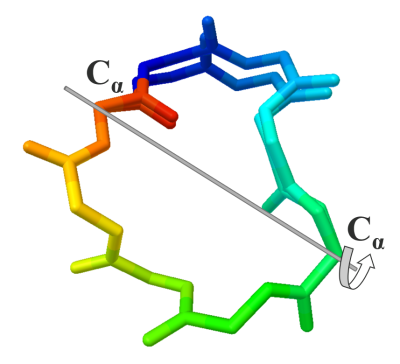
- Zhang, Y.; Sanner, M. F. AutoDock CrankPep: combining folding and docking to predict protein–peptide complexes. Bioinformatics 2019. doi:10.1093/bioinformatics/btz459 (preprint PDF, supplementary PDF)
- Zhang, Y.; Sanner, M. F. Docking flexible cyclic peptides with AutoDock CrankPep. J. Chem. Theory Comput. 2019. doi:10.1021/acs.jctc.9b00557