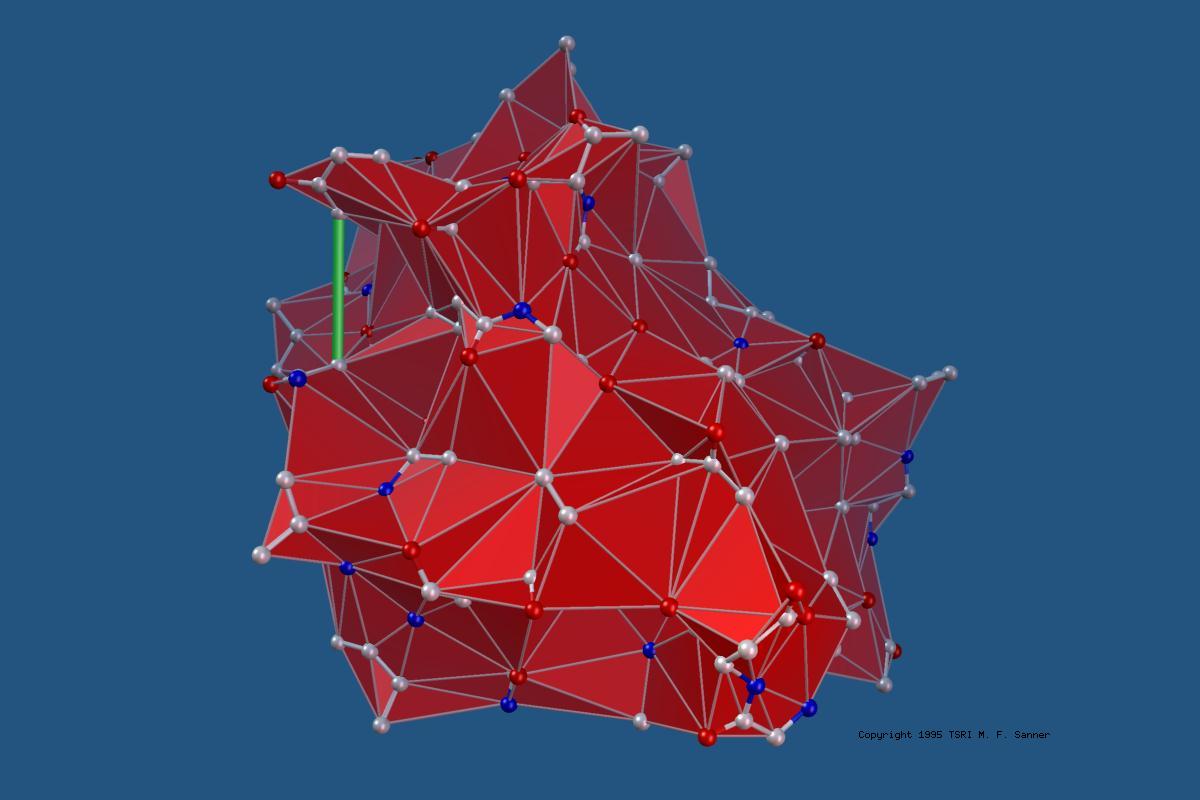
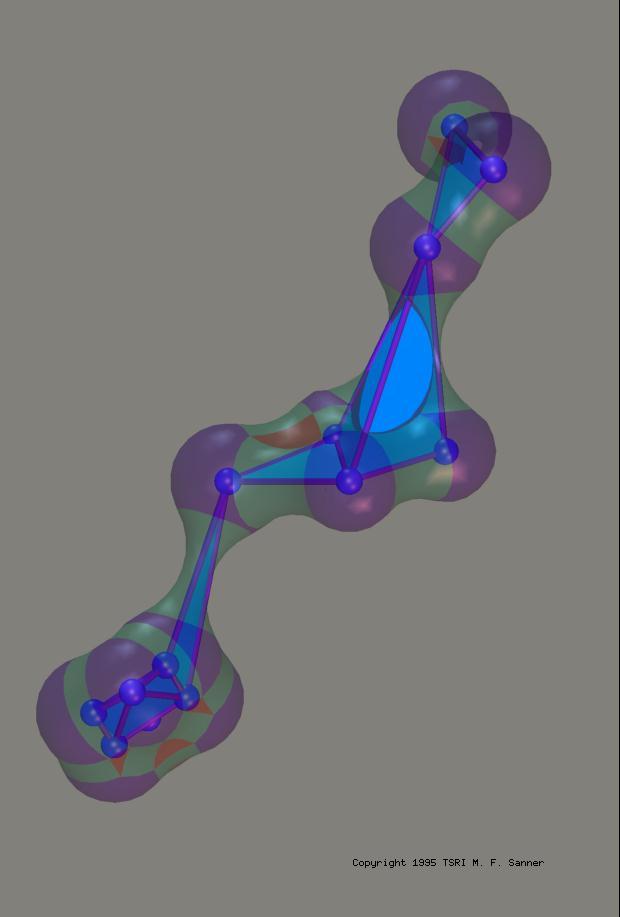
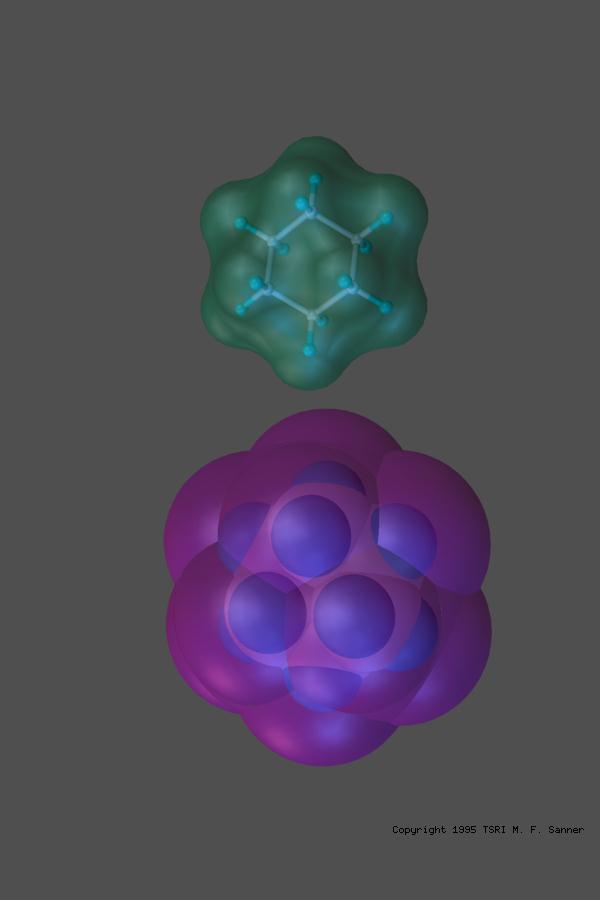
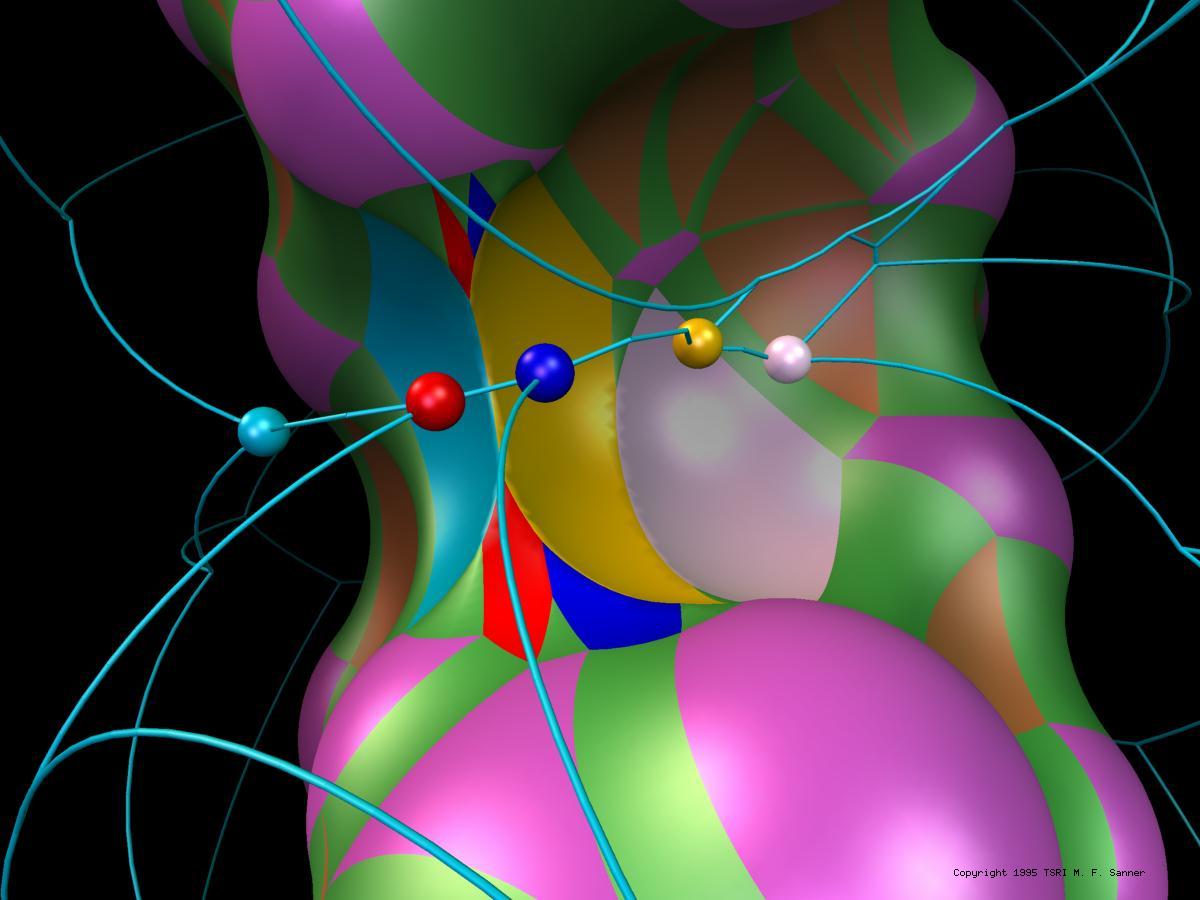
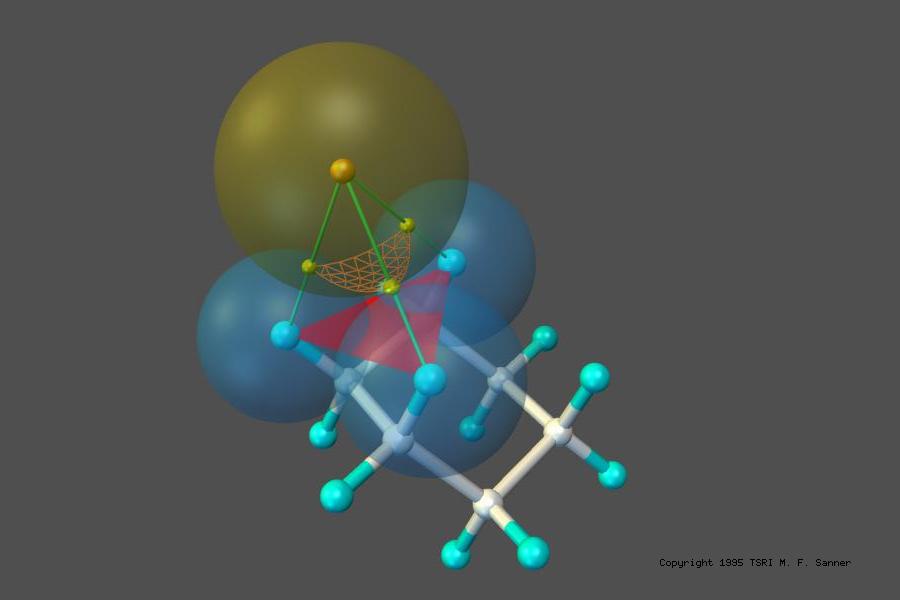
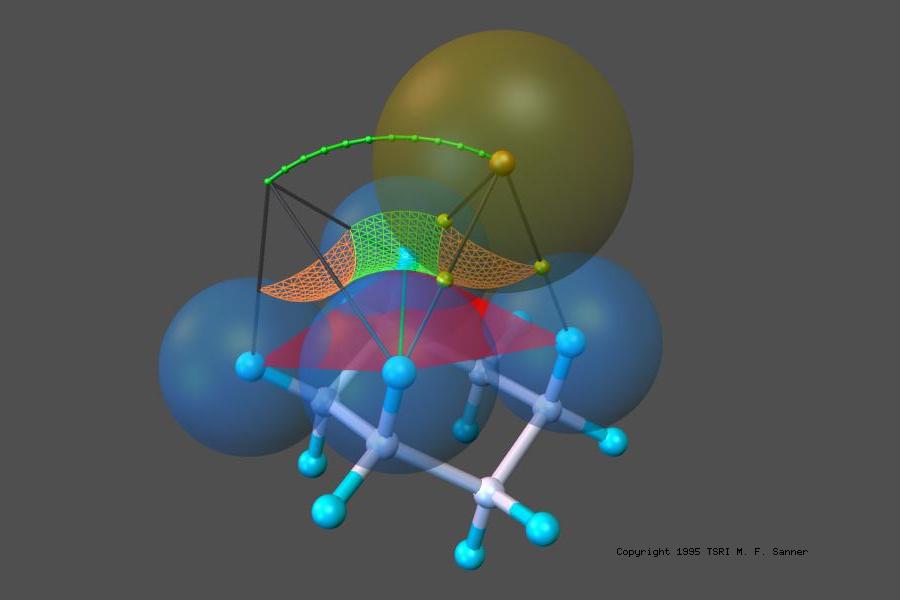
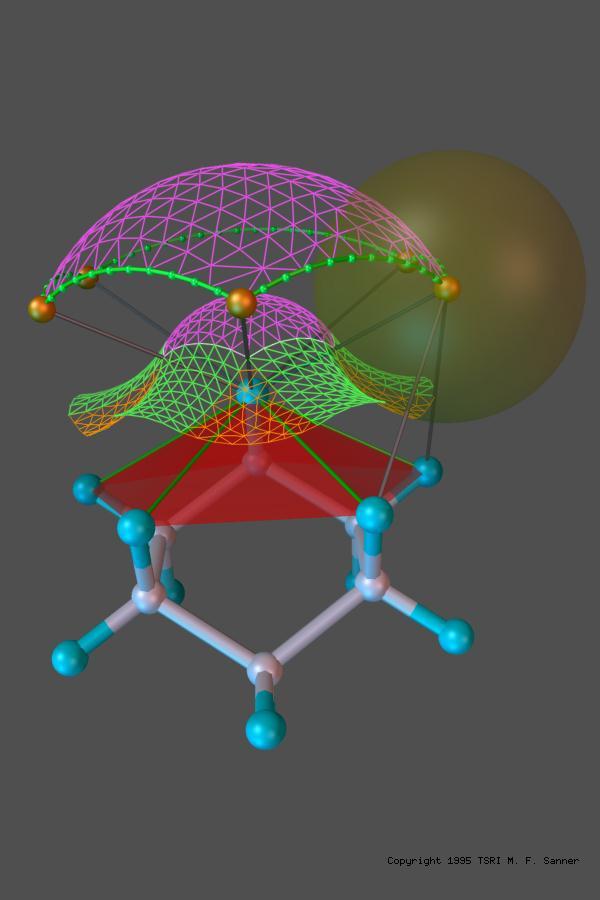
MSMS is a fast algorithm for computing molecular surfaces. Michel Sanner developed it as part of his Ph.D. thesis. It has been widely used to compute and display the solvent excluded surface (SES) of proteins. This surface is also known as the Lee and Richards surface, after the authors who first defined it by rolling a probe sphere, representing a solvent molecule, over the spheres representing the protein atoms. It is also called the Connolly surface, after Mike Connolly, who wrote the first program to compute it analytically.
The 1996 paper describing MSMS has been cited more than 2,700 times (2,721 according to Google Scholar on November 10, 2026). MSMS is used by several molecular visualization programs, including VMD, Chimera and our own PMV. It also computes the molecular surfaces used by MaSIF (Gainza et al., Nature Methods, 2020), a geometric deep-learning method that learns interaction fingerprints from protein surfaces, and by methods built on it, such as MaSIF-PMP for protein–membrane binding. It is available as a standalone program, and as a library with Python bindings in the MGLTools and ADFRsuite distributions.
MSMS is free for non-commercial use, under the Sannerlab MIT-like Source-Available License. Commercial use needs a separate license; see License.
How to cite
If you use MSMS in your work, please cite:
- Sanner, M. F.; Olson, A. J.; Spehner, J.-C. Reduced surface: an efficient way to compute molecular surfaces. Biopolymers 1996, 38, 305–320. doi:10.1002/(SICI)1097-0282(199603)38:3<305::AID-BIP4>3.0.CO;2-Y